
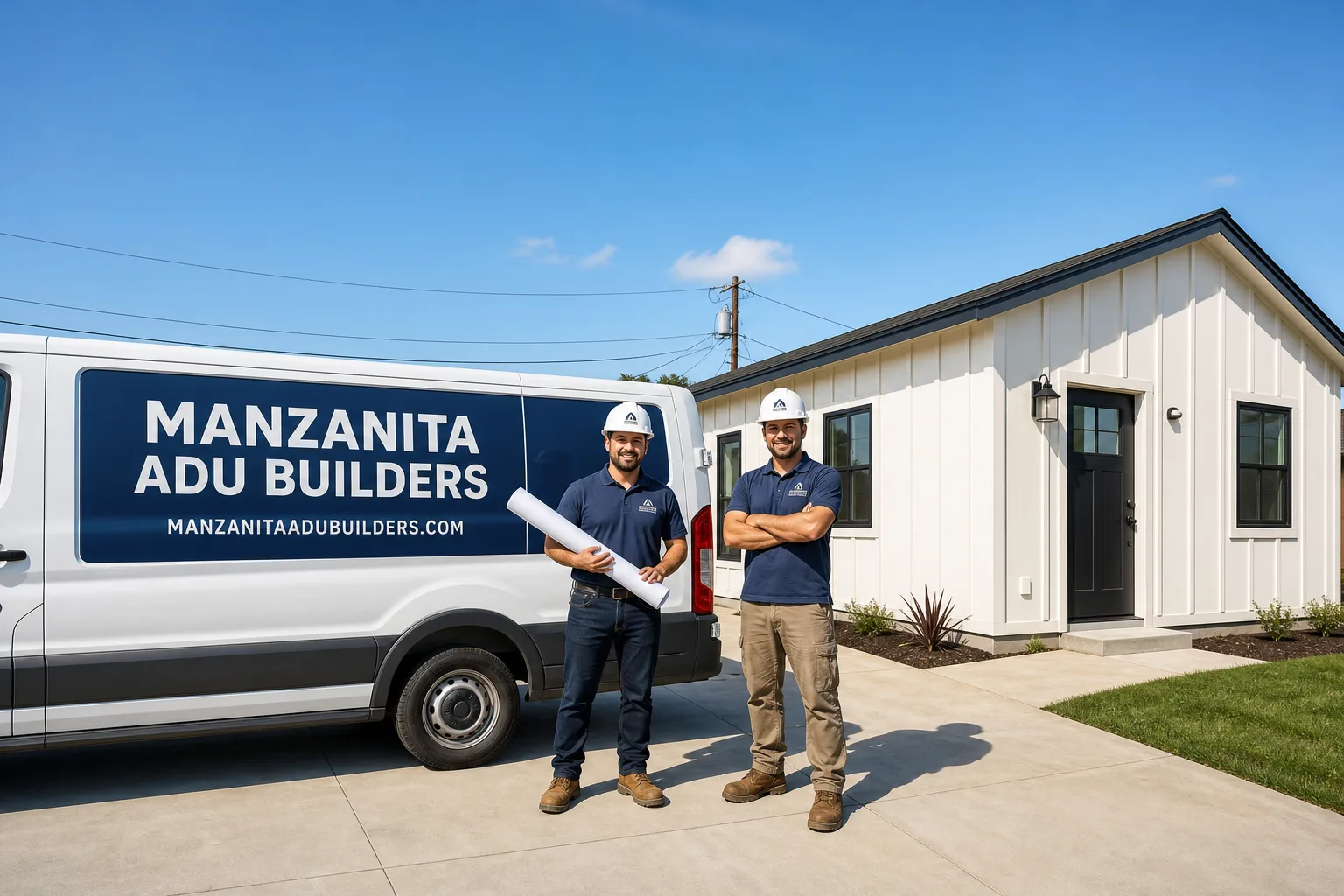
Fast, Reliable ADU Builders Across Corona
A detached ADU in Corona typically runs $180,000 to $320,000 for a stick-built one-bedroom unit, while garage conversions land between $120,000 and $190,000 depending on the existing slab and utility rough-ins. Prefab units from manufacturers like Dvele or Plant Prefab usually fall between $220,000 and $400,000 all-in once site work, foundation, and utility connections are accounted for. We work across all four Corona ZIP codes – 92882, 92877, 92878, and 92883 – and we know exactly what Corona’s HOA design committees and building department will ask for before you file. Call (833) 467-4140 and we’ll walk your lot and give you a straight answer on what’s actually buildable.
Key Takeaways:
- Corona ADUs often need HOA architectural review stacked on top of city permitting, especially in subdivisions like Corona Ranch, Wildrose, and Sierra Del Oro.
- Detached backyard ADUs and garage conversions are the two most common formats here, matched to existing stucco-and-tile tract aesthetics.
- We file the full submittal packet for you, including the HOA architectural application, so the project doesn’t stall mid-build.
- Manzanita ADU Builders is manufacturer-agnostic – we’ll compare Dvele, Mighty Buildings, Boxabl, Plant Prefab, and stick-built options against your lot and budget, not a sales quota.
Why Manzanita ADU Builders Is Corona’s Preferred ADU Builders Company
Corona homeowners don’t need a contractor who has built one ADU somewhere else. They need someone who has sat through Corona Municipal Code plan checks and knows that a project on a Horsethief Canyon tract lot faces an entirely different approval path than one on a wide lot off Grand Boulevard near the Circle. Noel Carrasco built Manzanita ADU Builders around exactly that gap. We have worked through HOA design-review kickbacks on tile profile and paint color in Corona Ranch, and we have pulled detached ADU permits on older lots near North Main where the setback math actually works without a variance.
Our ADU Builders team handles the full scope under one contract. That means the crew doing the slab and framing is the same crew finishing the bathroom tile and kitchen cabinets. No gap between “the ADU is built” and “the ADU is livable.” For a city where most detached units need to read as original construction against a 1990s stucco-and-Spanish-tile backdrop, that finish continuity matters more than homeowners expect.
We also know what Corona’s climate does to an ADU. Triple-digit summer heat in the Santa Ana River corridor means cooling load is not a checkbox. We spec ductless mini-splits sized for inland Riverside County, not a coastal formula, and we detail stucco and fiber-cement exteriors for UV and wind-driven dust. James Hardie lap siding or panel systems show up on a lot of our Corona garages and backyard units because they hold paint better than stucco alone and clean up after a Santa Ana event without repainting.
Backyard ADU in Corona
A backyard ADU in Corona is most often a detached one-bedroom or studio unit set behind the primary tract home on lots in neighborhoods like Corona Ranch, Wildrose, or the wider parcels near the downtown Circle. The first thing we check is how much of the rear yard the existing structure and hardscape already consume, because many 1980s-2000s subdivisions were platted with rear yards that shrink fast once you subtract side and rear setbacks under Corona Municipal Code.
For a detached stick-built backyard unit in 92882 or 92877, budget $200,000 to $320,000 for a finished one-bedroom with a full bath and a compact kitchen. A smaller studio ADU, around 400 to 500 square feet, commonly lands between $165,000 and $230,000. Prefab backyard units, including Boxabl and Plant Prefab models, run $220,000 to $400,000 depending on the site work, foundation type, and utility trenching your specific lot requires.
Stucco and Tile Matching for Master-Planned Communities
In subdivisions where the HOA architectural committee reviews the submittal, the roofline and exterior finish have to look like the primary home, not like a structure dropped in from a catalog. We match the existing Spanish tile or concrete S-tile profile and stucco color, often before the first plan check comment comes back. That preemptive matching is why some Corona projects sail through architectural review on the first pass while others stall.
Lots Where the Setback Math Actually Works
The older, wider lots near the downtown Circle and along the North Main corridor clear Corona’s setback and lot-coverage standards far more easily than typical tract parcels in newer subdivisions. On those larger lots, a detached backyard ADU often needs no variance at all, which can cut weeks out of the approval calendar and thousands out of the hard costs.
Written by Noel Carrasco, Owner at Manzanita ADU Builders, serving Corona and western Riverside County.
ADU Construction in Corona
ADU construction in Corona is rarely just about framing four walls. It is about sequencing the build around two approval tracks that run in parallel but at different speeds: the city submittal and the HOA architectural review. We build ADU construction schedules around that reality, so your slab is not poured, and your framing is not dropped, until both approvals are in hand.
A full ADU construction project in Corona, including site prep, foundation, framing, mechanical, drywall, finishes, and a kitchen and bath, will typically run $180,000 to $320,000 for a stick-built detached unit. Garage conversions under the same full-scope model usually fall between $120,000 and $190,000. Those ranges include plans, permits, and finish-level interior work. They do not include the hidden cost of redoing work after an HOA kickback, which is exactly the failure we prevent.
Sequencing Construction Around City and HOA Approvals
In Corona Ranch we built a detached backyard ADU on a 1990s stucco-and-tile lot where the HOA design committee wanted the unit’s roofline and paint to read as original construction, so we matched the existing Spanish tile profile and stucco color before filing. Our crew ran it as a James Hardie-clad garage conversion side-by-side with a stick-frame backyard unit, scheduling the slab and framing to start only after HOA sign-off and city approval cleared so neither shell sat open through a Santa Ana wind event.
Single-Contractor Interior Scope
We finish what we start. The same team framing the ADU also handles the bathroom and kitchen interior, which means the unit is deliverable as a rentable, livable space, not a shell waiting on a separate remodel contractor. For a Corona homeowner putting the unit on the 91-corridor rental market, that is the difference between collecting rent in month six and chasing punch-list items in month nine.
Trusted Brands We Service in Corona
We work across the leading prefab manufacturers without a supplier relationship steering the recommendation. That includes Dvele for high-performance smart ADUs, Mighty Buildings for panelized construction, Boxabl for compact deployable units, and Plant Prefab for sustainability-focused modular builds. For Corona homeowners, the brand conversation always starts with lot dimensions, HOA constraints, and cooling load. We stock common trim, flashing, and James Hardie exterior components for quick adjustments during Corona installs, which means a design-review amendment that changes a paint color or roofline detail does not stall the schedule for weeks of material ordering.
From foundation to finished kitchen, one team handles it. Prefab or site-built: we know both, and we’ll tell you which makes sense for your project.
Common ADU Builders Problems We See in Corona Homes
- HOA architectural kickback after the city submittal is already filed. The design committee rejects a paint color, roof pitch, or wall height, and the project stalls mid-plan check. We file the HOA packet and the city submittal together, matched to the primary home, so this is resolved before it becomes a delay.
- Urban alley-ADU templates misapplied to tract lots. Two-story designs with minimal setbacks work in Los Angeles or Orange County’s older urban cores, not on a Sierra Del Oro lot already at lot-coverage limits. We draft units to Corona’s actual code, not a recycled city template.
- Undersized cooling on a Santa Ana River corridor lot. Triple-digit summer heat and wind-driven dust punish stucco and tile if the mechanical design is copied from a coastal standard. We size mini-splits for inland Riverside County and detail exteriors for UV and dust, not marine fog.
- Projects that sit half-finished waiting on a committee. A slab poured before HOA approval can sit open through a wind event, cracking and collecting dust. Our build schedules do not start framing until approvals clear, so no shell is left exposed to Santa Ana winds.
Pricing for ADU Builders in Corona, CA
Corona pricing tracks the inland Riverside County market, which runs lower than coastal Orange County but higher than more rural parts of the Inland Empire. A detached backyard ADU in Corona typically lands between $180,000 and $320,000 for a stick-built one-bedroom with a full bath and kitchen. Garage conversions run $120,000 to $190,000. Prefab and modular units from Boxabl, Mighty Buildings, Dvele, or Plant Prefab fall between $220,000 and $400,000 including site work and utility connections. What moves the number most on a Corona lot is whether the parcel sits in an HOA with design review, whether the existing slab or foundation can be reused on a garage conversion, and how far trenching has to go to reach the panel and water line. Call (833) 467-4140 for a written line-item estimate on your specific address. Estimates are free.
We Also Serve Cities Near Corona
Manzanita ADU Builders works throughout the 91 and 71 corridors. Beyond our ADU Builders in Corona work, we take projects in Chino, Yorba Linda, Trabuco Canyon, and Los Serranos. Each city carries its own approval quirks, and we file the full submittal packet, including any HOA architectural application, for every one of them.
Serving Corona, CA — Our Local Coverage Area
We’re based in the Corona area and know this community well. Use the map below to see our service coverage — if you’re nearby, we can almost certainly help.
FAQs About ADU Builders in Corona
In subdivisions like Corona Ranch, Wildrose, Horsethief Canyon, and Sierra Del Oro, the HOA design committees typically require the ADU to match the primary home’s exterior: the same stucco color family, the same Spanish tile or concrete S-tile profile, and a roofline that reads as original construction rather than an add-on. James Hardie fiber-cement lap or panel exteriors get approved regularly when painted to match the home, because committees recognize the material as a durability upgrade, not a style break. The safest path is to match the existing home exactly and file the HOA architectural packet at the same time as the city submittal. Call (833) 467-4140 and we’ll review your HOA’s specific design guidelines before you commit to a plan set.
We do. Noel Carrasco and the Manzanita team prepare and file both the city submittal with the Corona building department and the HOA architectural application for your specific subdivision. That includes the site plan, elevations, material specs, and any design-review forms the HOA requires. Filing both tracks at once is the single biggest scheduling lever on a Corona ADU, because the city and the HOA review in parallel rather than sequentially. We handle the full packet so nothing sits on your dining table half-complete.
HOA architectural review typically adds 30 to 60 days on top of the city plan check, depending on the committee’s meeting cycle and whether the first submittal matches the primary home closely enough to pass without revisions. A submittal that preemptively matches tile profile, paint color, and roofline clears faster than one that treats the HOA as an afterthought. That is why we match materials before filing rather than waiting for the kickback. For exact timing on your subdivision, call (833) 467-4140 – the answer changes block by block.
The older lots near the downtown Circle and along the North Main corridor were platted wider and deeper, which means a detached ADU fits within Corona’s setback and lot-coverage standards without a variance. In newer master-planned communities, the rear yards are smaller and the CC&Rs predate state ADU law, so a detached unit often means fighting both the HOA design committee and the city over every foot of setback. The older neighborhoods also tend to have fewer active HOAs, which removes an entire approval track from the calendar.
We sequence the build so no structural work starts until both the city permit and the HOA architectural approval are in hand. That means the slab is not poured, the framing is not dropped, and the roof is not left open through a Santa Ana wind event while a committee debates paint color. We also order long-lead materials, like custom tile profiles and James Hardie exterior products, early in the approval window so they are on site when the schedule clears. If you want a Corona ADU that moves through approvals without stalling, call (833) 467-4140 for a free on-site estimate.
Written by Noel Carrasco, Owner at Manzanita ADU Builders, serving Corona since our first tract-lot project in the area.
Ready to see what fits your Corona lot? Call (833) 467-4140 and we’ll walk the property, check the setback math, and give you a written line-item estimate. Whether it’s a backyard ADU, a garage conversion, or a prefab unit from Dvele, Mighty Buildings, Boxabl, or Plant Prefab, we’ll match the build to your lot, your budget, and your HOA’s rules – not the other way around.