James Hardie ADU Builders in Stanton: A Homeowner’s Guide
James Hardie fiber cement siding shows up on nearly every ADU spec sheet in Southern California, but the phrase “Hardie” describes at least seven different products, not one. In Stanton specifically, where summer UV is harsher than coastal Orange County and the marine layer burns off early, choosing the right Hardie substrate and finish determines whether your ADU exterior looks sharp for 15 years or needs repainting in three. Here’s what to actually ask your builder before Hardie goes on your walls.
The Hardie Product Matrix: Plank, Panel, and Architectural Are Three Different Decisions
Most homeowners in Stanton hear “James Hardie” and picture horizontal lap siding. That’s HardiePlank, and it’s a fine product. But it’s not always the right one for an ADU. Here’s the matrix we walk clients through:
- HardiePlank lap siding – the classic horizontal board look. Good for matching a traditional stucco-and-siding Stanton home where the ADU sits close to the main structure. Available in 4-inch and 7-inch exposures. The 7-inch exposure tends to look better on a small ADU because fewer horizontal lines make the structure feel wider.
- HardiePanel vertical siding – large sheets with vertical grooves or smooth faces. On a 600-square-foot backyard unit, vertical panels reduce the number of seams and end-joints, which matters because water intrusion at joints is the most common Hardie failure point on small structures. Panel also gives a more contemporary look, which reads as intentional on a modern ADU.
- Hardie Architectural Collection – includes products like Artisan lap, Reveal panel, and V-Groove. This is James Hardie’s premium line with deeper shadow lines and custom-profile options. It’s pricier and rarely necessary on a rental ADU, but on a multigenerational unit where the exterior needs to match a high-end primary home, it’s the right tool.
What we see in Stanton is that builders quote “Hardie siding” generically. The homeowner assumes they mean HardiePlank. Then the builder actually installs HardiePanel because it’s faster on a small building. Both are legitimate, but the aesthetic outcome is completely different. A good ADU builder in Stanton should tell you which product they’re pricing and why, not just write “Hardie” on the contract.
Stanton’s Microclimate: Why ColorPlus Finish Makes More Sense Here Than Coastal California
Stanton sits inland enough that the marine layer that blankets Huntington Beach or Seal Beach most mornings typically burns off by 9 or 10 AM. That means more direct sun hours and higher surface temperatures on your ADU’s south-facing and west-facing walls. Fiber cement holds up to UV well, but the painted finish is what degrades.
This is where James Hardie’s ColorPlus Technology matters. ColorPlus is a factory-applied, multi-coat finish baked onto the siding before it leaves the plant. It’s more fade-resistant and more uniform than site-painted Hardie, and it carries a 15-year finish warranty on most products. In Stanton’s sun exposure, site-painted fiber cement often needs re-coating within 5 to 7 years. ColorPlus stretches that meaningfully.
The tradeoff: ColorPlus limits you to James Hardie’s curated palette of roughly 25 colors. For a primary home remodel, that can feel restrictive. For an ADU, it’s usually a non-issue. You want the ADU to coordinate with the main house, not replicate it exactly. We’ve steered Stanton clients toward the warm neutrals – Sandstone Beige, Timber Bark, Monterey Taupe – because they read well against the city’s common stucco and don’t fight with the primary home’s existing palette.
If your lot gets full afternoon sun and the ADU’s west wall faces open sky, choose a lighter ColorPlus finish. Darker colors absorb more heat and accelerate the expansion-contraction cycle that stresses caulk joints on a small structure. That’s a Stanton-specific consideration, not something you’ll read on the James Hardie website.
Installation Differences: Why an ADU Is Harder to Side Correctly Than a House
Here’s a counterintuitive truth our crews learn on every ADU job: siding a 500-square-foot backyard unit takes more care per linear foot than siding a 2,000-square-foot house. The reason is geometry.
- More cuts, shorter runs. An ADU has windows, doors, and corners packed into a small wall plane. That means more cut ends, and every cut end of Hardie is a moisture entry point unless properly sealed. On a big house, long uninterrupted runs mean fewer cuts. On an ADU, almost every board gets cut.
- End-sealing matters more. James Hardie requires cut edges to be sealed with a compatible sealant or edge-coat before installation. Skipped end-sealing is the leading cause of early fiber-cement failure we see in Stanton, including on ADUs built by general contractors who treat the unit like a shed. Water wicks into the cut edge, the board swells, paint delaminates, and three years later the homeowner is paying for siding replacement.
- Ground clearance is tighter. Many Stanton backyards have established landscaping or hardscape near where the ADU goes. Hardie requires 6 inches of clearance from the finished grade to the bottom edge of the siding. On a slab-on-grade ADU with a low roofline, that clearance gets compromised if the builder isn’t watching it. We’ve seen installers bury the bottom course in soil or mulch, which voids the warranty.
- Corner and window flashing on small walls. Flashing details that are routine on a house become awkward on an ADU because the wall segments between openings are only a few feet wide. This is where a builder familiar with ADU-specific geometry earns their fee. The Hardie installation manual is written for houses, and applying it to a compact structure requires judgment.
If you’re in Stanton and evaluating ADU builders in Stanton, ask specifically how they handle cut-edge sealing on Hardie installations. A contractor who gives you a blank look is telling you something important.
Matching Hardie to Stanton’s Home Styles So the ADU Reads as Intentional
Stanton’s housing stock is a mix: mid-century single-story homes, 1970s and 80s stucco boxes, and a growing number of renovated flips with mixed-material facades. The challenge with an ADU is that it’s usually built at the rear of the lot, visible from the main home’s living areas but not necessarily from the street. Still, buyers and appraisers notice when the ADU looks like an afterthought.
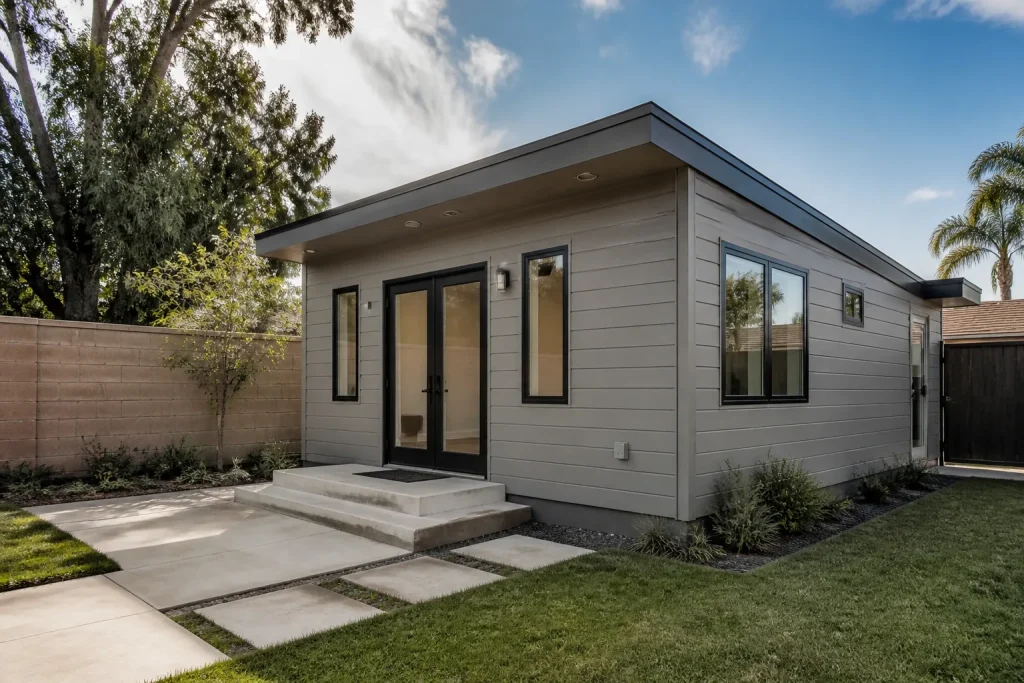
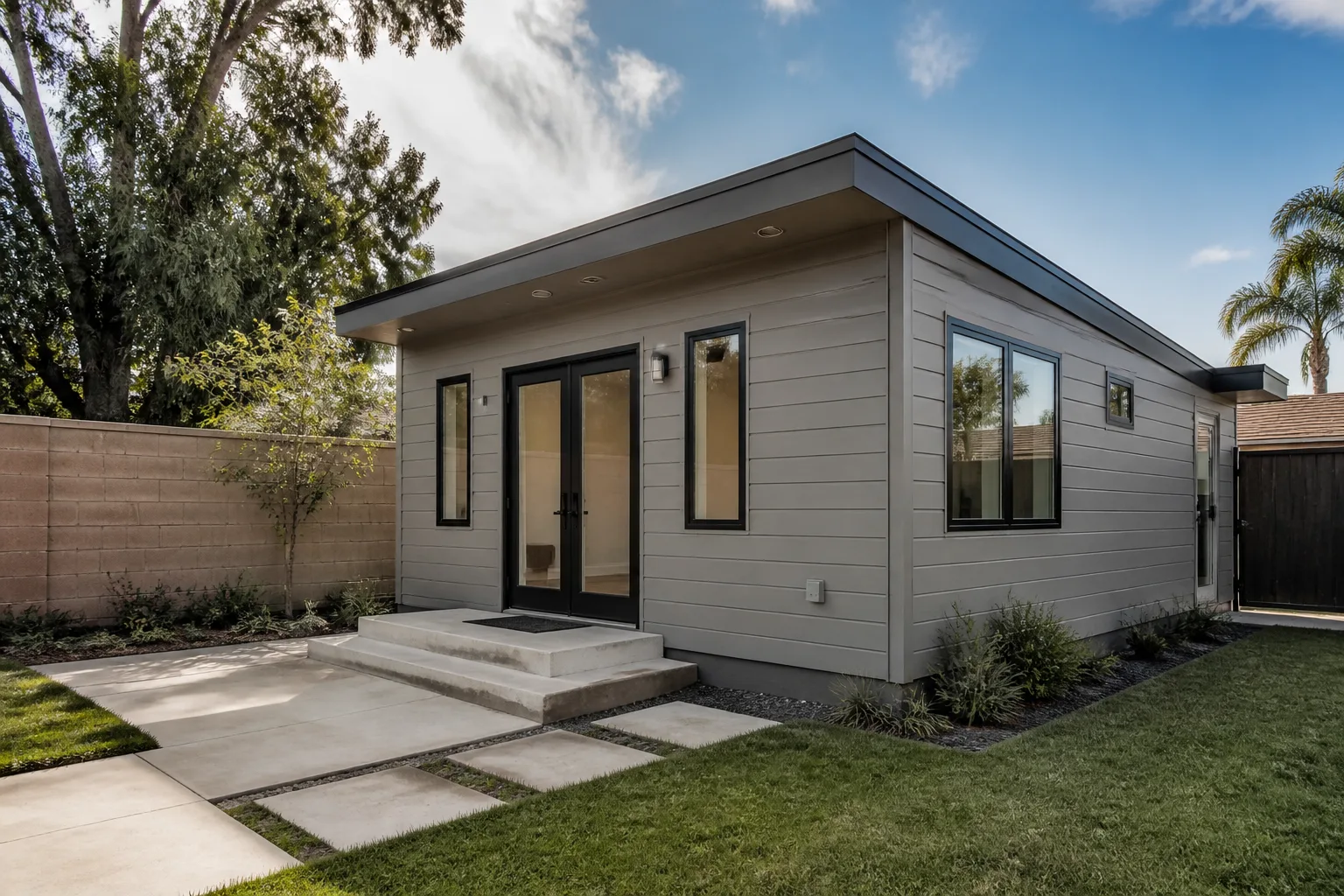
The most successful Hardie ADU exteriors we’ve done in Stanton follow a simple rule: match the profile language of the primary home, not the exact material. If the main house is stucco with horizontal definition lines, a HardiePlank lap at 7-inch exposure in a warm neutral reads as a deliberate companion structure. If the main house has vertical board-and-batten accents, HardiePanel with battens in a matching tone works beautifully.
Where homeowners go wrong is mixing profiles. A HardiePlank ADU next to a stucco house is fine. A HardiePlank ADU with HardiePanel gable ends, a different trim color, and a third roof color looks like a construction demo. Keep the palette tight: one siding product, one trim color, one roof color. The ADU should be quieter than the primary home, not louder.
James Hardie exteriors bring a longevity benefit to Stanton specifically because fiber cement resists the warping and cracking that vinyl siding shows under inland heat. That matters for a rental ADU where maintenance is deferred. You’re not up on a ladder repainting every five years, and your tenant isn’t living next to peeling trim. The curb appeal holds, which protects the property’s overall value.
Hardie Certification: What “We Use Hardie” Actually Means
Every contractor in Orange County can buy Hardie at a lumberyard. Buying the product and installing it correctly are different things. James Hardie runs a contractor program with tiers, and the language matters when you’re interviewing ADU builders in Stanton.
Here’s the distinction we think homeowners should understand:
- Hardie-preferred installer – a contractor or crew that has completed James Hardie’s installation training and can access extended warranty options. They’ve demonstrated familiarity with the product’s fastening schedule, clearance requirements, and flashing details. This is what you want for an ADU.
- General contractor who “uses Hardie” – buys the product because it’s standard, but may not have trained on it. No access to enhanced warranties, no accountability to the manufacturer beyond the standard product warranty.
The practical difference surfaces a few years after the build. If a Hardie-preferred installer makes an installation error, the pathway to warranty coverage is clearer and the manufacturer is more likely to stand behind it. If a GC without certification makes the same error, the homeowner and the contractor are left fighting it out.
When you interview Manzanita ADU Builders home or any other contractor, ask directly: “Is your crew Hardie-certified, and who holds the warranty?” A straight answer is a good sign. Hemming and hawing is not.
What Hardie Adds to the Prefab ADU Discussion
One of the persistent myths about prefab ADUs is that you’re stuck with whatever exterior the factory ships. That’s true for some manufacturers and false for others. When we help Stanton homeowners compare prefab options – including Abodu, Cover, and Dvele – the exterior finishing is part of the conversation from day one.
Some prefab units arrive with the Hardie exterior already installed at the factory. That’s genuinely good: factory installation means controlled conditions, consistent sealing, and no on-site weather exposure during the siding process. Other prefab units arrive with a structural shell that gets finished on-site, which means your local crew’s Hardie competence matters exactly as much as it does on a stick-built ADU.
We work with all the leading prefab brands – so you compare options, not salespeople. What that looks like in practice on a Stanton lot: we’ll look at your setbacks, your sun exposure, your budget, and your finish goals, then tell you honestly whether a factory-finished Hardie exterior or a site-finished custom profile makes more sense. The answer differs from lot to lot. If a contractor only sells one prefab brand, you’re hearing a sales pitch, not a recommendation.
When to Call a Pro
Siding an ADU is not a weekend project, and it’s not the place to save money with a handyman. Fiber cement is heavy – a 12-foot HardiePlank board weighs around 35 pounds – and the material is silica-based, which means cutting it produces dust that requires proper respiratory protection. The fastening schedule is specific, and missing a stud means a board that sags or cracks within the first year.
The moment to bring in a specialist is before the ADU design is finalized. Exterior cladding choices affect wall thickness, window trim details, and foundation overhang. Retrofitting decisions later costs real money. If you’re planning an ADU in Stanton, the ADU Builders in Stanton decision should happen before you’re committed to plans, not after.
Related services in Stanton: if you’re already planning a full ADU with a finished interior, our bathroom remodeling in Stanton and kitchen remodeling in Stanton scopes fold into the same contract, which means the crew framing your walls is the same crew setting your tile. No handoff, no dropped details.
The Bottom Line
James Hardie is an excellent exterior choice for ADUs in Stanton, but “Hardie” is a product family, not a single product. Match the profile to your lot and your primary home, choose a ColorPlus finish in a mid-tone warm neutral if your ADU gets full sun, verify that your builder seals cut edges and maintains ground clearance, and confirm they hold Hardie installation certification rather than simply buying the product. Get those four things right and your ADU exterior will look sharp for over a decade with minimal maintenance.
If you’re in Stanton and want help thinking through Hardie options, prefab vs. site-built, or the full ADU scope, Manzanita ADU Builders offers free estimates. Call (833) 467-4140 to schedule one. We’ll walk your lot, look at your sun exposure and setbacks, and tell you honestly which Hardie product – and which construction path – makes sense for your budget and timeline.
Frequently Asked Questions
For a typical 500-to-800-square-foot ADU in Stanton, budget $8 to $14 per square foot of wall area for installed HardiePlank with ColorPlus finish, or $10 to $16 per square foot for HardiePanel and Architectural Collection profiles. Labor, cut-edge sealing, trim, and flashing details drive the final number. Call (833) 467-4140 for a line-item quote specific to your lot – estimates are free.
It depends on your design goals. HardiePlank gives a traditional horizontal look that matches many Stanton homes. HardiePanel gives a vertical, more contemporary look and has fewer seams, which reduces moisture-entry points on a small structure. We walk each client through both options against their specific ADU design before pricing.
Yes. Some prefab manufacturers we work with – including Abodu, Cover, and Dvele – offer factory-installed Hardie exteriors, and for units that arrive as shells, we install Hardie on-site. We’re manufacturer-agnostic, so the recommendation is driven by your lot and budget, not by a preferred brand.
With ColorPlus factory finish, expect 15 years or more before any re-coat, even with Stanton’s inland sun exposure. Site-painted Hardie typically needs re-coating in 5 to 7 years. Choosing a lighter ColorPlus tone for full-sun walls extends finish life further. Call (833) 467-4140 to discuss color selection for your specific lot orientation.
Written by the team at Manzanita ADU Builders, serving Stanton since 2014.
Need ADU Help?
Call Manzanita ADU Builders — licensed & insured, here with fast after-hours help in Stanton.
(833) 467-4140